The Discovereye project was a project built during my 3rd year of University.
The briefing was given by Discovery Channel in The Netherlands:
- Create a (fully working) interactive installation prototype within 6 weeks which inspires children.
- The winner will be given a budget to further improve their installation and will be showcased at the Discovery festival in Amsterdam.
The Concept
During the exploration phase we came across a video of American astrophysicist Neil deGrasse Tyson explaining how “We” on earth are all made out of stardust/ atoms, just like all the other stars and planets in our universe.
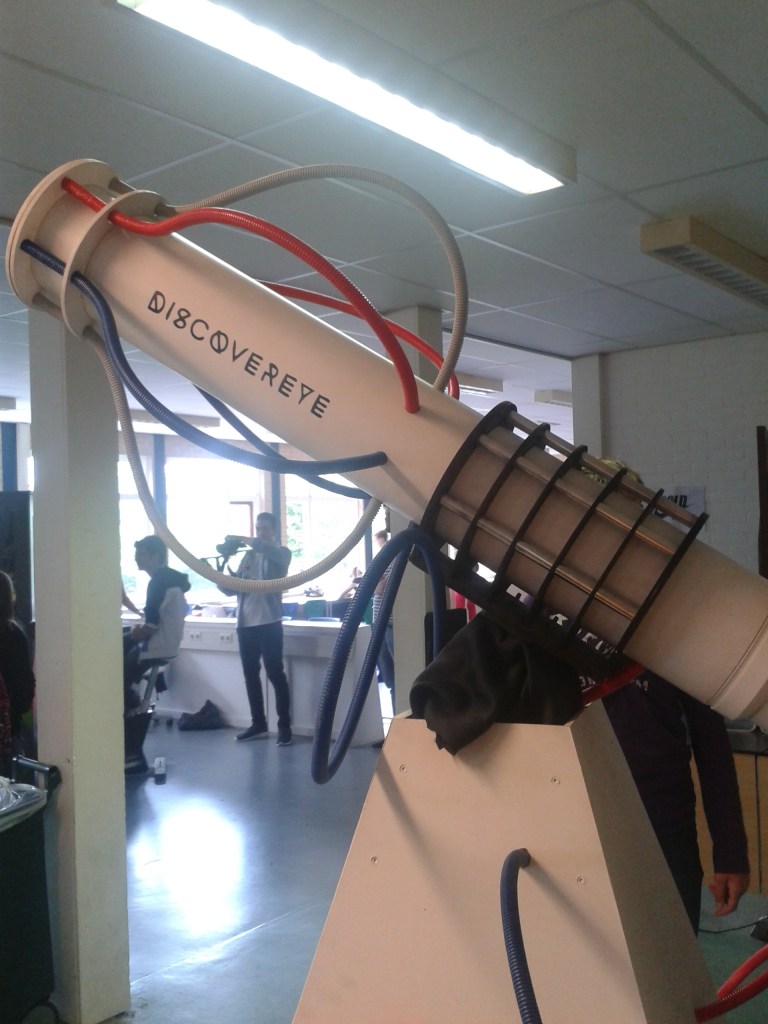
With this idea in-mind my team started a number of brainstorming sessions which led us to the idea of a telescope that allows us to look at planets and outside of our world.
As we are looking through our eyes to see everything around us, we took this as the starting point.
To be a bit more precise, the iris.
After testing with multiple digital cameras taking photos of our eyes and working out ways to create a level of interactivity we invested in a digital microscope to even zoom in more. This microscope turned out to be a crucial part of the installation.
To create a connection between the stars and planets in our universe and us as people here on earth we created a video loop with footage of planets and galaxies that could be seen floating around in space.
We created an goggle marked in the picture below as blue. The goggle consists of 2 parts, a small screen on which the viewer can see the video footage and the other side of the goggle has the microscope filming the viewer’s eye.
The user is able to alter the footage and “zooming” in by turning a large focusing knob on the side of the housing.
The planets and galaxies slowly transition to a 20x zoomed-in live feed of the viewers iris/eye creating the connection between them and the universe.
Final result
Our installation was nominated in the top 3 by Discovery Channel, The Netherlands
During the final decision we got a 2nd place overall out of 25 installations.


How does it work?
In short,
Step 1: The viewer looks through the goggles and can see a video of moving planets and galaxies.
Step 2: The user can turn the focusing knob on the side of the housing, zooming in and out and changing the video footage.
Step 3: Inside the goggle, a USB microscope is constantly filming the user’s eye. This footage is used to overlay the planets when the user zooms all the way in, creating the connection between them and the universe.

 Jai Boekhout